Lead UX Designer │ Optimasi.ai │ Indonesia
Lead UX Designer │ Optimasi.ai │ Indonesia
News monitor dashboard
News monitor dashboard
News monitor dashboard
See beyond the headlines
See beyond the headlines

Introduction – The problem space
Introduction – The problem space
Set the context with today’s reality:
01
01
The flow of news and opinions on digital media is accelerating, both on national news portals and social media platforms like X
The flow of news and opinions on digital media is accelerating, both on national news portals and social media platforms like X
02
02
Distinguishing between credible information and potential hoaxes is increasingly difficult
Distinguishing between credible information and potential hoaxes is increasingly difficult
03
03
At the same time, users want to know the impact of news: engagement levels, hoax , and public sentiment
At the same time, users want to know the impact of news: engagement levels, hoax , and public sentiment
In an era of information overload, how can we evaluate the credibility of news, understand public sentiment, and track its real-time impact?
In an era of information overload, how can we evaluate the credibility of news, understand public sentiment, and track its real-time impact?
Opportunity
Opportunity
Why this solution matters:
Sentinel serves as a futuristic dashboard that helps users instantly assess news sentiment, credibility, and impact with clarity and confidence
Sentinel serves as a futuristic dashboard that helps users instantly assess news sentiment, credibility, and impact with clarity and confidence
User need
Sentiment analysis, hoax risk detection, reach, and engagement breakdown
Sentiment analysis, hoax risk detection, reach, and engagement breakdown
Benchmarking
Existing tools (e.g., Brandwatch, Talkwalker) are strong in analytics but weak in credibility checks
Existing tools (e.g., Brandwatch, Talkwalker) are strong in analytics but weak in credibility checks
Local context
Initial scope focuses on Indonesian national news portals and social media (X) for relevance
Initial scope focuses on Indonesian national news portals and social media (X) for relevance
Key pages
Key pages
Dashboard Overview – The Command Center
Dashboard Overview – The Command Center
Imagine a control room where hundreds of news articles and thousands of social media conversations metric are collected into a single view
Imagine a control room where hundreds of news articles and thousands of social media conversations metric are collected into a single view

AI summary
Provides a quick snapshot: how many news items have been analyzed, how many from social media, and how many hoaxes were detected
Provides a quick snapshot: how many news items have been analyzed, how many from social media, and how many hoaxes were detected
Engagement metrics
Visualized through a bar chart (mentions, likes, shares, comments)
Visualized through a bar chart (mentions, likes, shares, comments)
Sentiment bar chart
Helps the team instantly see whether public opinion is leaning positive, negative, or neutral
Helps the team instantly see whether public opinion is leaning positive, negative, or neutral
Top 3 trending news table
Show the highest-performing news, complete with overall rank, headline, source, engagement, sentiment, hoax level, and a trendline
Show the highest-performing news, complete with overall rank, headline, source, engagement, sentiment, hoax level, and a trendline
Key pages
Key pages
News Card Page – The News Explorer
News Card Page – The News Explorer
After understanding the big picture, the team can dive deeper
After understanding the big picture, the team can dive deeper
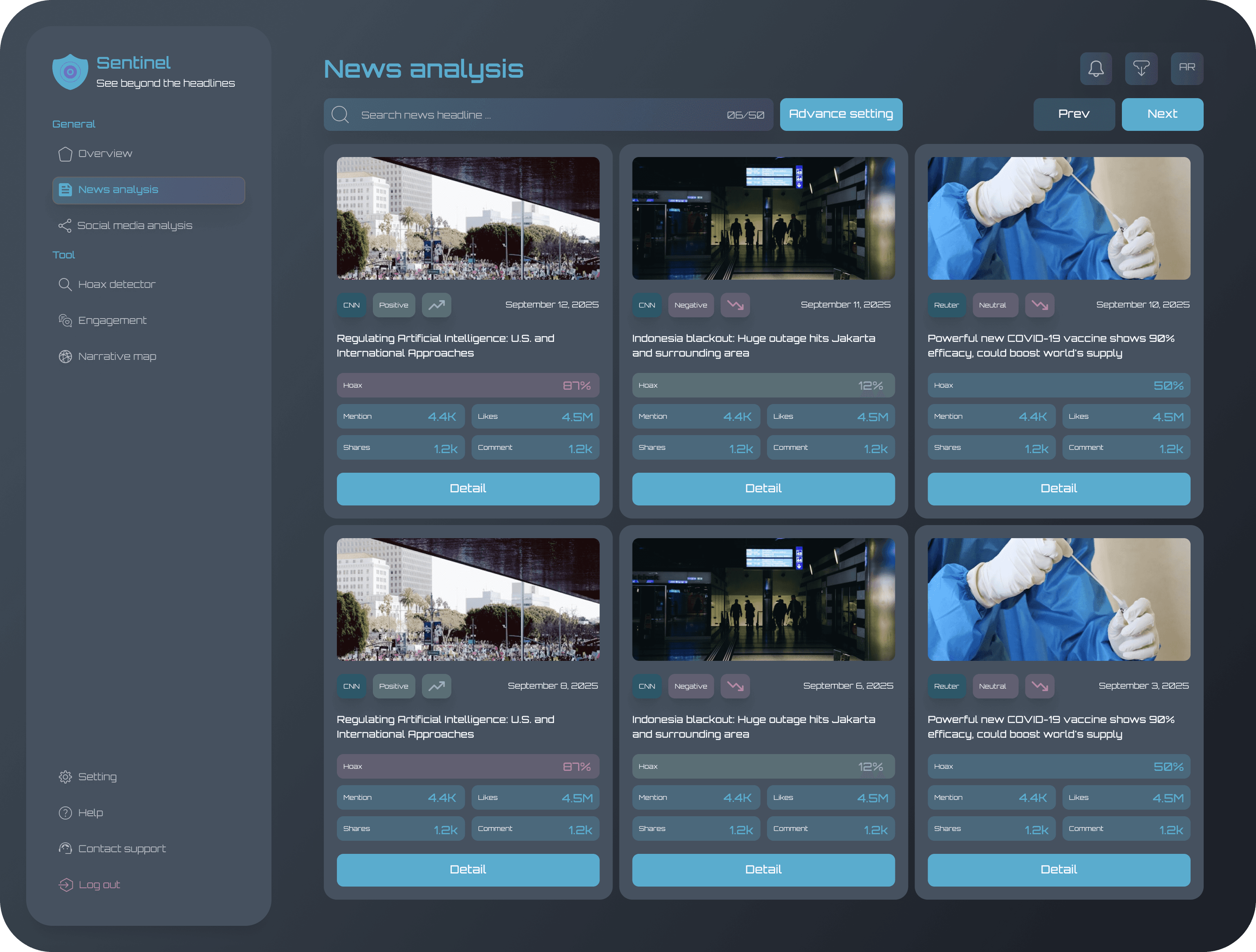
AI news cards
Mini page of each article: image, source, sentiment, trendline, publication date, headline, hoax level, mentions, likes, comments, shares, and a detail button.
AI news cards
Mini page of each article: image, source, sentiment, trendline, publication date, headline, hoax level, mentions, likes, comments, shares, and a detail button.
Search & advanced filters
To find specific news items or refine by sentiment, hoax level, engagement, or source
To find specific news items or refine by sentiment, hoax level, engagement, or source
Pagination
Ensures smooth navigation even when hundreds of stories are streaming in daily
Ensures smooth navigation even when hundreds of stories are streaming in daily
Key pages
Key pages
News Card Detail Page – The Deep Dive
News Card Detail Page – The Deep Dive
Every story has its own layers
Every story has its own layers
Hoax detection tab
Sentences flagged as questionable, plus a list of pro and contra sources from cross-checking
Sentences flagged as questionable, plus a list of pro and contra sources from cross-checking
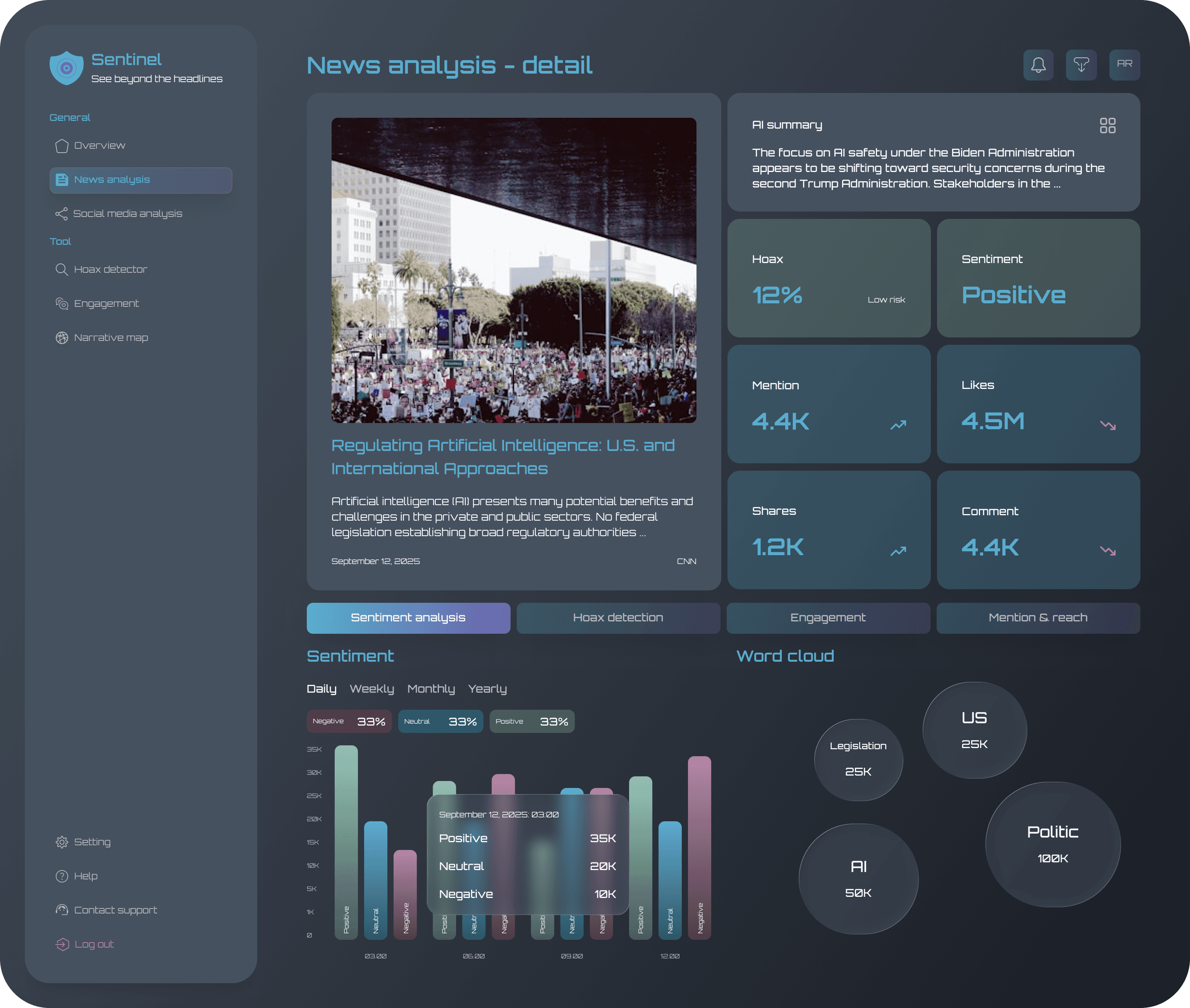
Sentiment analysis tab
Sentiment bar chart + a word cloud of the most frequent terms
Sentiment bar chart + a word cloud of the most frequent terms
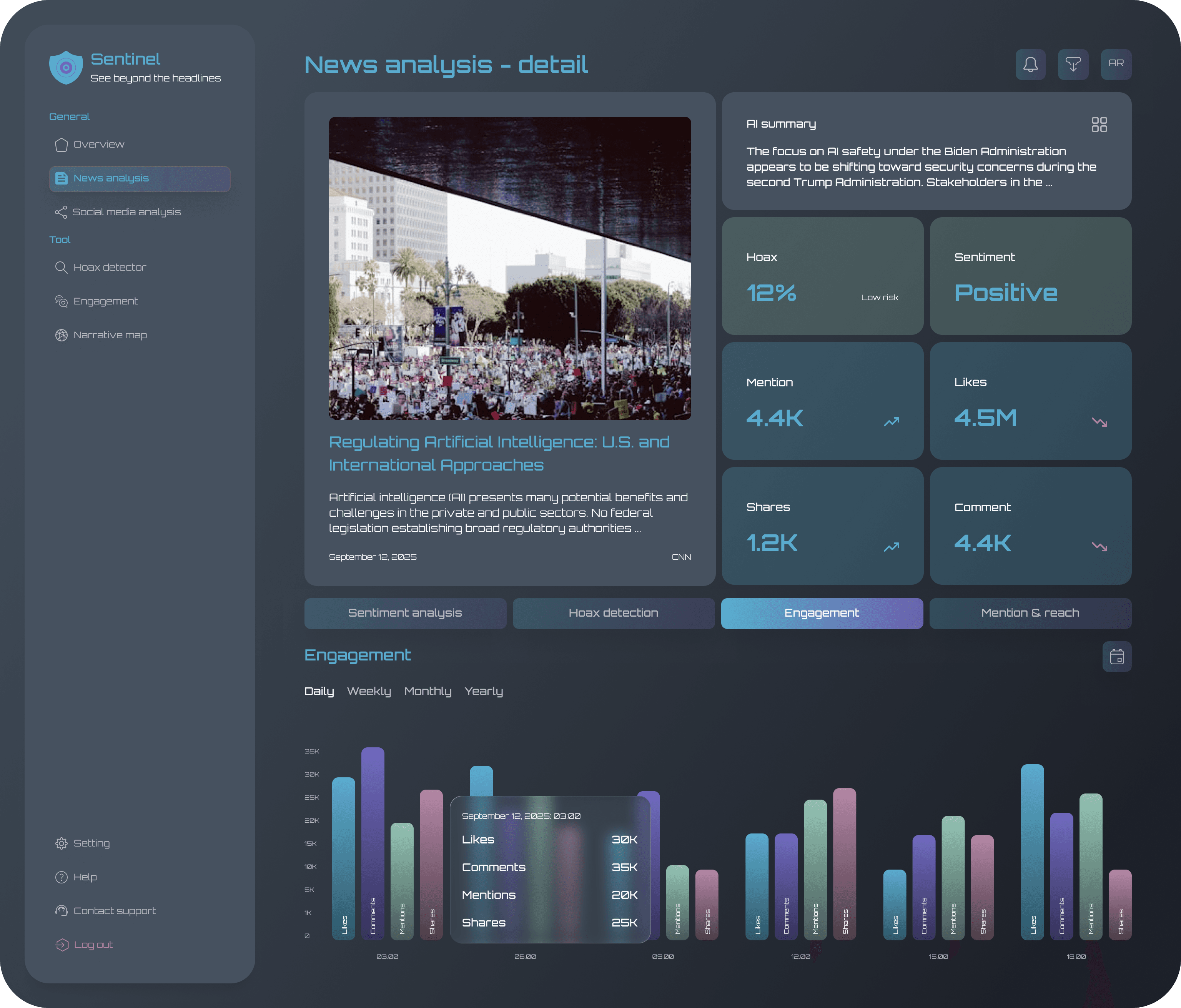
Engagement tab
Bar chart of interactions (likes, shares, comments, mentions)
Bar chart of interactions (likes, shares, comments, mentions)
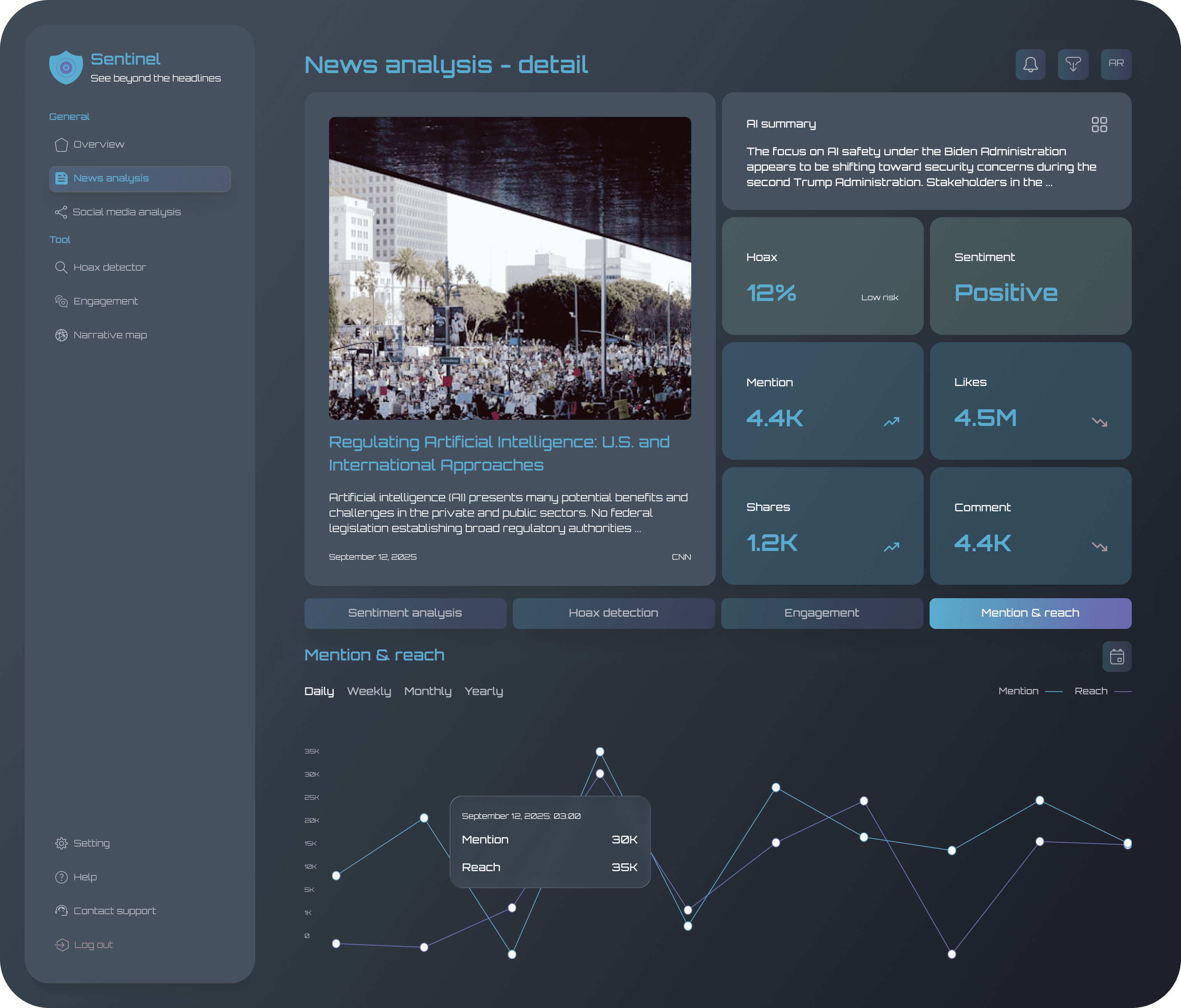
Mention & reach tab
Line chart visualizing how often the story is mentioned and how far it spreads across social media
Line chart visualizing how often the story is mentioned and how far it spreads across social media

Important algorithm
Sentiment analysis algorithm
Goal: classify news or social media posts into Positive, Neutral, or Negative sentiment

01
Data collection
Crawl news articles & social media posts (X, FB)
Extract text content (headline, body, captions, comments)

02
Preprocessing (NLP)
Tokenization → breaking text into words/sentences
Stopword removal → remove common words (such as in, to, that)
Lemmatization/Stemming → convert words to their root form
Handle emoji/slang (specifically for social media)
03
Feature extraction
Bag-of-Words / TF-IDF → to capture word frequency
Embeddings (BERT/IndoBERT) → for semantic context

04
Sentiment classification
Modern (preferred): Transformer model (IndoBERT / mBERT

05
Output
Sentiment label: Positive, Neutral, Negative
Confidence score (%) → example: 78% Negative, 15% Neutral, 7% Positive
01
Data collection
Crawl news articles & social media posts (X, FB)
Extract text content (headline, body, captions, comments)
02
Preprocessing (NLP)
Tokenization → breaking text into words/sentences
Stopword removal → remove common words (such as in, to, that)
Lemmatization/Stemming → convert words to their root form
Handle emoji/slang (specifically for social media)
03
Feature extraction
Bag-of-Words / TF-IDF → to capture word frequency
Embeddings (BERT/IndoBERT) → for semantic context
04
Sentiment classification
Modern (preferred): Transformer model (IndoBERT / mBERT
05
Output
Sentiment label: Positive, Neutral, Negative
Confidence score (%) → example: 78% Negative, 15% Neutral, 7% Positive
01
Data collection
Crawl news articles & social media posts (X, FB)
Extract text content (headline, body, captions, comments)
02
Preprocessing (NLP)
Tokenization → breaking text into words/sentences
Stopword removal → remove common words (such as in, to, that)
Lemmatization/Stemming → convert words to their root form
Handle emoji/slang (specifically for social media)
03
Feature extraction
Bag-of-Words / TF-IDF → to capture word frequency
Embeddings (BERT/IndoBERT) → for semantic context
04
Sentiment classification
Modern (preferred): Transformer model (IndoBERT / mBERT
05
Output
Sentiment label: Positive, Neutral, Negative
Confidence score (%) → example: 78% Negative, 15% Neutral, 7% Positive
01
Data collection
Crawl news articles & social media posts (X, FB)
Extract text content (headline, body, captions, comments)
02
Preprocessing (NLP)
Tokenization → breaking text into words/sentences
Stopword removal → remove common words (such as in, to, that)
Lemmatization/Stemming → convert words to their root form
Handle emoji/slang (specifically for social media)
03
Feature extraction
Bag-of-Words / TF-IDF → to capture word frequency
Embeddings (BERT/IndoBERT) → for semantic context
04
Sentiment classification
Modern (preferred): Transformer model (IndoBERT / mBERT
05
Output
Sentiment label: Positive, Neutral, Negative
Confidence score (%) → example: 78% Negative, 15% Neutral, 7% Positive
Important algorithm
Hoax detector algorithm
Goal: evaluate credibility of a news item and flag potential misinformation

01
Claim extraction
NLP parses the text → identify “claims” (subject + predicate + object)
Example: “Government shuts down internet in city X."
02
Cross-source verification (Hybrid approach)
Trusted sources database (official news portals, government statements)
Fact-checking DB (e.g., Mafindo, Google Fact Check Tools)
Other major outlets (cross-check consistency)

03
Textual similarity check
Use embeddings (cosine similarity via BERT/Doc2Vec)
If multiple trusted sources contradict → raise credibility risk

04
Network propagation analysis (Social media)
Track how the claim spreads on social media
Was it first posted by unverified or anonymous accounts?
Does it spread mainly in closed echo chambers?
05
Scoring system
Combine multiple signals into Credibility Score (0–100)
Weight for trusted sources support
Weight for contradictions from fact-checkers
Weight if originated from suspicious/unverified accounts.

06
Scoring system tresholds
80–100 → Likely credible
40–79 → Medium risk
0–39 → High risk / potential hoax

07
Output
Credibility Score
Highlight suspicious sentences (e.g., “shuts down internet” flagged ⚠️)
Show “Supporting vs Contradicting Sources” in UI
01
Claim extraction
NLP parses the text → identify “claims” (subject + predicate + object)
Example: “Government shuts down internet in city X."
02
Cross-source verification (Hybrid approach)
Trusted sources database (official news portals, government statements)
Fact-checking DB (e.g., Mafindo, Google Fact Check Tools)
Other major outlets (cross-check consistency)
03
Textual similarity check
Use embeddings (cosine similarity via BERT/Doc2Vec)
If multiple trusted sources contradict → raise credibility risk
04
Network propagation analysis (Social media)
Track how the claim spreads on social media
Was it first posted by unverified or anonymous accounts?
Does it spread mainly in closed echo chambers?
05
Scoring system
Combine multiple signals into Credibility Score (0–100)
Weight for trusted sources support
Weight for contradictions from fact-checkers
Weight if originated from suspicious/unverified accounts.
06
Scoring system tresholds
80–100 → Likely credible
40–79 → Medium risk
0–39 → High risk / potential hoax
07
Output
Credibility Score
Highlight suspicious sentences (e.g., “shuts down internet” flagged ⚠️)
Show “Supporting vs Contradicting Sources” in UI
01
Claim extraction
NLP parses the text → identify “claims” (subject + predicate + object)
Example: “Government shuts down internet in city X."
02
Cross-source verification (Hybrid approach)
Trusted sources database (official news portals, government statements)
Fact-checking DB (e.g., Mafindo, Google Fact Check Tools)
Other major outlets (cross-check consistency)
03
Textual similarity check
Use embeddings (cosine similarity via BERT/Doc2Vec)
If multiple trusted sources contradict → raise credibility risk
04
Network propagation analysis (Social media)
Track how the claim spreads on social media
Was it first posted by unverified or anonymous accounts?
Does it spread mainly in closed echo chambers?
05
Scoring system
Combine multiple signals into Credibility Score (0–100)
Weight for trusted sources support
Weight for contradictions from fact-checkers
Weight if originated from suspicious/unverified accounts.
06
Scoring system tresholds
80–100 → Likely credible
40–79 → Medium risk
0–39 → High risk / potential hoax
07
Output
Credibility Score
Highlight suspicious sentences (e.g., “shuts down internet” flagged ⚠️)
Show “Supporting vs Contradicting Sources” in UI
01
Claim extraction
NLP parses the text → identify “claims” (subject + predicate + object)
Example: “Government shuts down internet in city X."
02
Cross-source verification (Hybrid approach)
Trusted sources database (official news portals, government statements)
Fact-checking DB (e.g., Mafindo, Google Fact Check Tools)
Other major outlets (cross-check consistency)
03
Textual similarity check
Use embeddings (cosine similarity via BERT/Doc2Vec)
If multiple trusted sources contradict → raise credibility risk
04
Network propagation analysis (Social media)
Track how the claim spreads on social media
Was it first posted by unverified or anonymous accounts?
Does it spread mainly in closed echo chambers?
05
Scoring system
Combine multiple signals into Credibility Score (0–100)
Weight for trusted sources support
Weight for contradictions from fact-checkers
Weight if originated from suspicious/unverified accounts.
06
Scoring system tresholds
80–100 → Likely credible
40–79 → Medium risk
0–39 → High risk / potential hoax
07
Output
Credibility Score
Highlight suspicious sentences (e.g., “shuts down internet” flagged ⚠️)
Show “Supporting vs Contradicting Sources” in UI
Reflection & next steps
Reflection & next steps